Same Song, Same Soul: Why Your Music Taste Is Actually a Compatibility Test
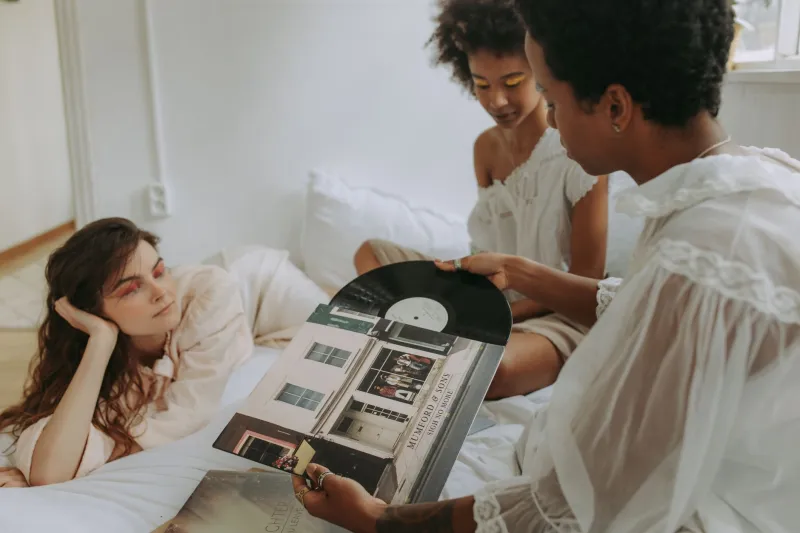
You're at a party, doing the small talk thing, and somewhere in the middle of a conversation about nothing in particular, you mention a band. Not a huge one. Not the kind of band everyone knows. Just a band you love. And the person across from you goes completely still for a second and says: "Wait, you know them?"
You know the feeling that comes next. It's not quite excitement and it's not quite relief, but it's somewhere in between — this sense that the social scaffolding just dropped away and you're suddenly talking to an actual person instead of a stranger performing friendliness. Something real just happened.
Music did that. It almost always does.
More Than a Vibe Match
Psychologists have spent a fair amount of time studying why shared musical taste produces this particular kind of connection, and the findings are pretty striking. Research from the University of Cambridge found that musical preferences reveal underlying personality traits with reasonable consistency — openness to experience, emotional sensitivity, the degree to which someone processes the world through feeling versus analysis. When you find someone who loves what you love, you're not just finding a person with similar taste. You're finding someone whose inner architecture resembles yours.
This is why the connection feels disproportionate to the information exchanged. You didn't just learn that someone likes the same band. You learned something about how they move through the world.
That's a lot of data to get from one conversation at a party.
The Specificity Problem (and Why It Works in Your Favor)
Here's the thing about music taste as a friendship signal: it gets more powerful the more specific it gets. Saying you like "hip-hop" tells someone almost nothing useful. Saying you think Madvillainy is a perfect record, or that you have strong opinions about the transition between Kendrick Lamar's good kid, m.A.A.d city and To Pimp a Butterfly, or that you've been obsessively listening to Billy Woods for two years — that's a different conversation entirely.
Specificity filters for the people who are actually your people.
This is something that music communities online figured out a long time ago, and it's basically the entire premise behind why places like CommonTunes exist. General music appreciation is fine, but it's not the thing that makes you stay up until 2 a.m. arguing about whether a band's third album was actually their best. That requires finding the people who care about the same specific things in the same specific way.
Fans in tight-knit music communities — the ones built around niche genres, regional scenes, or single artists — consistently describe their community members as "people who just get it" in a way that crosses over from musical preference into something that feels more personal. The music becomes a language, and everyone who speaks it fluently is already a little bit known to you before you've exchanged a word.
When the Music Gets There First
Some of the strongest friendships in music communities start with a song rather than a person. Someone posts a playlist, or a recommendation hits in a forum thread, or a stranger's comment in a music Discord catches your eye — and before any formal introduction happens, you already know something true about each other.
Talk to enough music fans and you'll hear variations of the same story: the friendship that started over a shared obsession with a deep cut, the relationship that survived distance because of a collaborative playlist, the group of people who met at a show and are still close a decade later because they all heard the same thing in the same song and recognized each other in it.
This isn't sentimentality. It's actually how human bonding works. Shared experience — especially shared emotional experience — accelerates intimacy in ways that conventional social interaction doesn't. Music is an extremely efficient delivery system for shared emotional experience. You hear the same song at the same moment and you're briefly inside the same feeling together. That's not a small thing.
The Limits of the Test
It's worth being honest about where this breaks down, though, because music taste is not a perfect predictor and pretending otherwise leads to a specific kind of snobbery that doesn't serve anyone well.
Some of the most genuinely compatible people you'll ever meet have completely different listening habits. Musical taste is one signal, not the only signal. And there's a version of "we like the same music" that functions more like gatekeeping than connection — where the shared taste becomes a credential you have to present to earn someone's respect, rather than an organic point of recognition.
The best music-based friendships aren't really about having identical taste. They're about having a similar relationship to music — the same level of investment, the same willingness to go deep, the same tendency to let songs mean something. You can build a great friendship with someone who loves country when you love jazz, if you're both the kind of people who actually listen.
Finding Your Frequency
What music compatibility really tests for isn't a specific genre or artist. It's the degree to which someone uses music as a serious tool for understanding themselves and the world. People who do that tend to be curious, emotionally literate, and genuinely interested in other people's inner lives. Those are good qualities in a friend.
The song is the handshake. The conversation that follows is where the friendship actually starts.
And if you've ever found yourself in a music community — online or in person — and felt that particular warmth of being around people who care about the same sounds you care about, you already know this isn't just about entertainment. It's about finding the frequency where you're most yourself, and discovering that some other people are tuned to exactly the same station.